- Quarter Zip Sports
- Posts
- How Golf Courses Can Be More Penal for Pros
How Golf Courses Can Be More Penal for Pros
Without Rolling the Ball Back

Quarter Zip Sports
December 28, 2025
The debate over distance in professional golf has become a referendum on equipment, but it doesn’t have to be. Courses already possess a rich, underused toolkit for challenging elite player, one rooted in strategy, angles, and consequence rather than yardage alone. Making courses more penal for professionals doesn’t require rolling the ball back; it requires restoring the idea that poor shots deserve punishment and smart play deserves reward.
First, width without forgiveness. Many modern setups narrow fairways indiscriminately, but that often hurts shorter hitters more than bombers, who can simply fly trouble. Instead, courses should widen landing areas while sharply differentiating where the ball finishes. A fairway that’s 45 yards wide is not benign if only 20 of those yards offer a clean angle into the green. Miss to the wrong side and the approach becomes blind, blocked, or forced to carry a hazard. This puts pressure on precision, not just power.
Second, reclaim the rough as a strategic hazard, not just a nuisance. Today’s primary rough often functions as a mild inconvenience for elite players, especially with wedges in hand. Graduated rough, short cut near fairways, progressively gnarlier as you stray, reintroduces decision-making. Combine this with thick collars around greens that grab the clubface and suddenly missing in the wrong spot costs real strokes. The goal isn’t lost balls; it’s uncertainty.
Third, firm, fast conditions are the great equalizer. Distance matters less when fairways repel careless drives and greens reject imprecise approaches. Firm turf rewards players who control trajectory and spin, and it punishes those who rely on height alone. A 190-yard approach to a firm green with a tucked pin is far more exacting than a 220-yard shot into a soft target. This is old-school golf at its best, and it’s thrilling to watch.
Fourth, green complexes should do the heavy lifting. Too many modern greens are large, flat, and receptive. Smaller targets with internal contours, false fronts, and sharp falloffs demand precise distance control. Miss in the wrong quadrant and the next shot becomes a defensive recovery, not a routine up-and-down. Pins tucked near edges aren’t unfair if surrounds are shaved tight and angles matter on the way in.
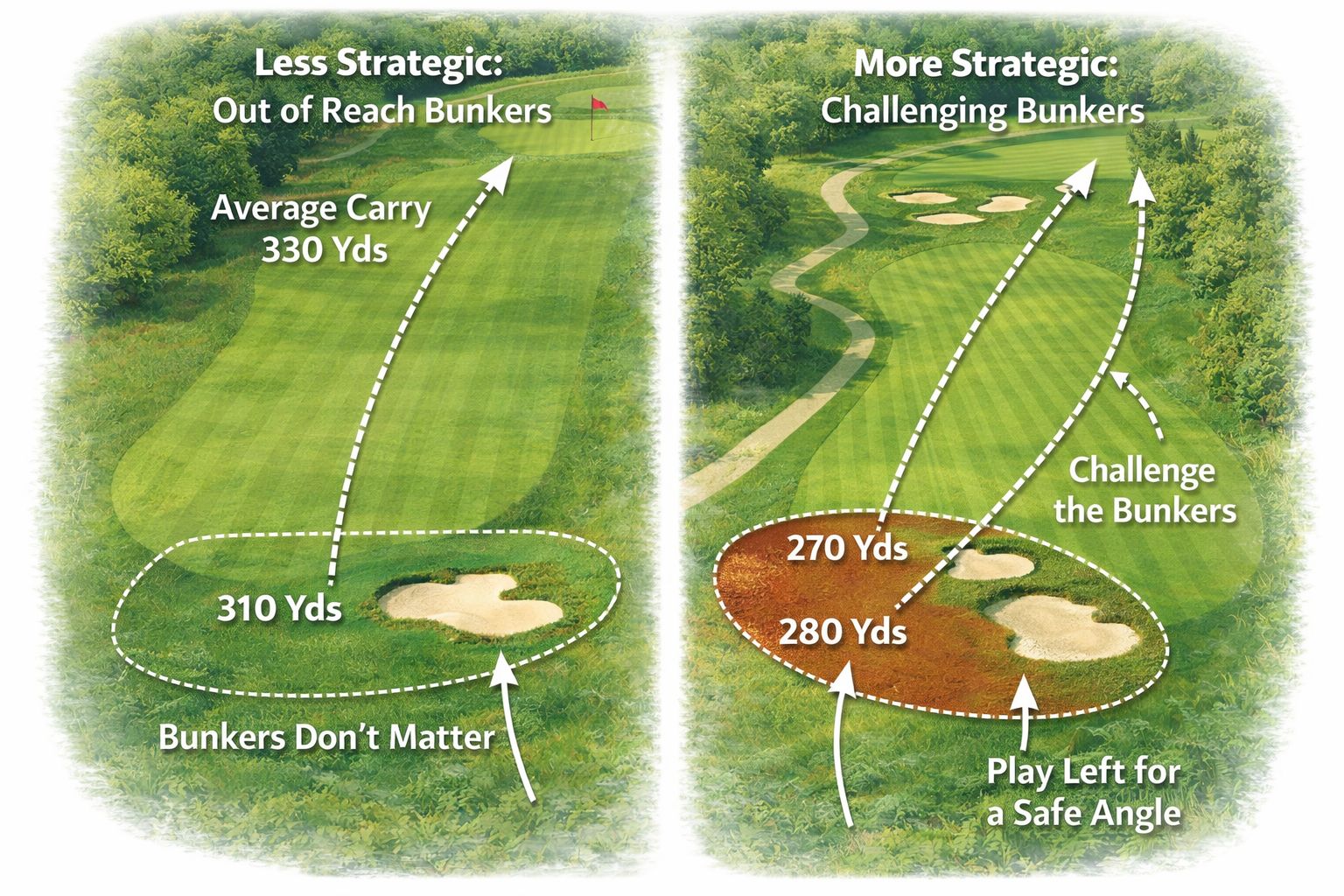
Fifth, hazards should be in play, not ornamental. Bunkers at 310 yards are meaningless when the average carry is 330. Instead of pushing hazards farther out, reposition them to challenge preferred lines and angles. Centerline bunkers, diagonal hazards, and cross bunkering force choices off the tee: challenge the danger for a better angle, or play safe and accept a tougher approach.
Finally, embrace variability. Daily pin positions, tee markers that subtly change angles, and weather-exposed setups keep professionals from solving a course once and coasting. Golf is at its best when it asks new questions each day.
The game doesn’t need less distance to be compelling. It needs more consequence. By emphasizing angles, firmness, and thoughtful punishment, courses can challenge the world’s best without touching the equipment at all.
Reply